
The border between reality and perception
There is a question I have asked myself for years, every time I opened a new infrared photograph on my screen. It was not a conscious question. It appeared on its own, before my brain had even finished processing what it was seeing.
Is this reality, or is it perception? After more than twenty years, I still do not have a final answer. But I stopped looking for one. Over time, I realized that maybe the question is more interesting than the answer.
WHAT DO WE MEAN WHEN WE SAY “REALITY”?

We are used to thinking that reality is what we see. It sounds obvious. It even sounds a little trivial. Yet it is one of the most fragile beliefs we have. Human beings are amazing, but we have many limits. Our eyes can only see a tiny part of the electromagnetic spectrum. Our ears can only hear a small part of the range of sounds that exist.
Everything outside the range our eyes can see—and those frequencies are enormous in both directions—simply does not exist for us. Not because it is not there, but because we do not have the biological tools to perceive it. So when we say that the sky is blue, that grass is green, or that skin has a certain color, we are not describing objective reality. We are describing our perception of a limited part of reality. One version of it. Not the only version. Without going too deeply into philosophy, think about people with different kinds of vision, such as color blindness or tetrachromacy. For them, the world does not look exactly the same as it does for other people.
Infrared photography reminds me of this every time I take a picture.
TWO PHOTOGRAPHS, THE SAME MOMENT
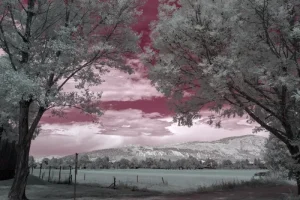
Imagine taking two photographs at exactly the same moment, in the same place, under the same light. One with a normal camera. The other with a camera modified for infrared photography. The two images will look like completely different worlds. Yet they are the same world. The same moment. The same light—simply observed through different tools. Which one is real?
The obvious answer would be: both.
But if we stop for a moment and think about that answer, we realize how unsettling it really is. Because it means that the reality we know—the one we take for granted every morning when we open our eyes—is only one of many possible versions of what exists. It is not false. But it is not complete.
THE ROLE OF PERCEPTION

Perception is not a window into reality. It is a filter. It filters what our senses are able to detect. It filters what our brain chooses to process from all the information it receives. It filters what our past experiences have taught us to recognize as important. In this sense, every human being lives in a slightly different version of the same reality. We see the same things, but not in the same way. We hear the same words, but we do not listen to them in the same way. We experience the same events, but we do not remember them in the same way.
Infrared photography makes this process visible in a direct and concrete way. Not through an abstract idea, but through an image. Something you can look at, show to others, and compare. Look at this photograph. Now look at how the same place appears to your eyes. Same reality. Completely different perception. Nothing more needs to be said.
WHEN PERCEPTION BECOMES TRUTH
There is one part of all this that I find especially fascinating, and it goes beyond photography. In everyday life, we often treat our perception as if it were absolute truth. Not only with what we see, but with everything. The people we meet. The situations we experience. The emotions we feel. We build a version of reality that seems solid, objective, and unquestionable. Then we act as if it were the whole truth. But that version is always and only our own. It is built on our senses, our personal history, and our limits.
Just like normal vision cannot see infrared light, it is not wrong—it is simply incomplete. How many times have we believed we understood a situation, a person, or a moment perfectly, only to discover later that there was something important we had missed? Not because someone hid it from us. Simply because our tools were not enough to see the whole picture. Infrared photography has taught me to be a little more humble about what I see. It has taught me that behind every apparent reality there is always something more. Something I cannot perceive, not because it does not exist, but because I have not yet found a way to see it.
THE BORDER THAT DOES NOT EXIST
After years of working with this invisible light, I have reached a temporary conclusion. The border between reality and perception does not exist. Or perhaps it does—but not where we think it does. It is not a clear line between true and false, or between objective and subjective. It is something much more subtle. It is the space where our tools end and the world continues.
And it is a huge space—much larger than we are usually willing to admit. Infrared photography lives exactly in that space. It does not invent anything. It does not lie. It simply shows a part of reality that our eyes cannot reach. And every time someone stands in front of one of my photographs and wonders whether what they are seeing is real, I feel that the question itself is already an answer.
Because it means that, for a brief moment, their idea of what is real has expanded a little. That is not a small thing. It may be one of the most important things a photograph can do.
AN OPEN QUESTION
I do not know whether there is a way to see reality exactly as it is. Probably not. We are too much a part of it to observe it from the outside. But I do know that every time I use a kind of light that my eyes cannot see to create a photograph, I am at least trying to look a little farther beyond the edge. Trying to move, even by a few millimeters, the limits of what I consider visible. It is not enough. It will never be enough.
But for now, it is what I know how to do.