
Why Infrared Changes Our Sense of Time?
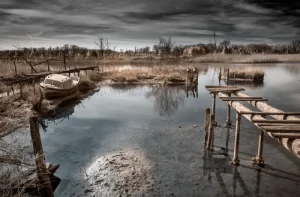
There are photographs that feel like they belong to yesterday. And there are photographs that seem to belong to no specific time at all. Infrared photographs almost always belong to the second group. I cannot tell you exactly when I first noticed it. It happened slowly over the years while looking through my archives. Images taken ten, fifteen, even twenty years ago that still feel current today. Not because they are timeless in the usual sense of the word, but because they seem to exist in a different relationship with time. As if time itself behaves differently inside those photographs.
I started wondering why.
TIME IN NORMAL PHOTOGRAPHS
A normal photograph grows old. It happens slowly, sometimes so slowly that we barely notice it, but it always happens. The colors of a certain period. A hairstyle. A car model in the background. A style of clothing. Even the quality of the light can remind us of a particular decade.
Without thinking about it, our brain reads these clues and places the image in time. It says: this photograph is from the 1980s. This one is from the early 2000s. This one is from today. It is an automatic process, almost unconscious. But it is powerful. And it completely affects the way we look at an image. An old photograph carries the weight of its time. We look at it already knowing—or at least guessing—when it was taken. And that changes everything. It changes how we see the people, the places, and the situations inside the frame. It places them in a defined past. It turns them into history.
WHAT HAPPENS WITH INFRARED
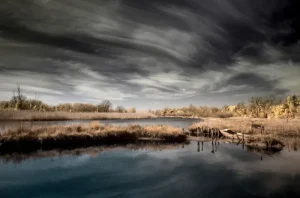
Infrared breaks this process in a very direct way. The first reason is visual. Bright skin that seems almost outside of time. Skies that become dark, sometimes nearly black. Trees and plants that turn white or golden. Colors that do not belong to any familiar palette from the past or the present. All of this removes the clues our brain normally uses to date an image.
The brain cannot easily say, “This was taken yesterday,” or, “This was taken thirty years ago.”
It loses its reference points. And when those reference points disappear, something interesting happens. The image stops belonging to one specific moment and starts belonging to all moments at the same time. It is a strange feeling. It is not nostalgia, because nostalgia needs a recognizable past. It is not modernity either. It is something suspended somewhere in between, something difficult to name.
THE LIGHT THAT DOES NOT AGE
There is a deeper part of this that I only understood with time. Infrared light is not tied to any particular photographic era. It does not have the grain of 1960s film photography. It does not have the digital look of the early 2000s. It exists independently from the technology used to capture it. It was here before cameras existed. And it will still be here long after us.
When I photograph in infrared, I am not using a contemporary light. I am using a light that has no age. And somehow that quality finds its way into the image. I have infrared photographs taken fifteen years ago that, when placed next to photographs taken last week, show no obvious sense of being from different periods. Not because they are the same. They are different, just as any two photographs are different. But neither one feels older or newer than the other.
Both exist in that same suspended space, outside the normal flow of time.
SUSPENDED TIME AS AN ARTISTIC CHOICE
When I began to understand this, I stopped seeing it as a technical feature of infrared photography. I started using it as a creative tool. In my photographic projects, time is almost always present as an underlying theme. The Weight of the Unspoken speaks about something that can no longer be changed or resolved. And what can no longer be changed belongs to a time that has closed forever. The Tears of Wood tells the story of nature slowly reclaiming what people have left behind.
What Your Eyes See Not follows the full arc of a life—from birth to death, from beginning to end. I could have created all of these projects with normal photography. But normal photography would have placed those images in a specific moment.
It would have said: this happened now, or yesterday, or twenty years ago. It would have tied the story to a particular point in time. Infrared leaves time open. It says: this has always happened. This is still happening. This will happen again. And that is exactly what I wanted to express.
WHY THE BRAIN FEELS IT AS TIMELESS
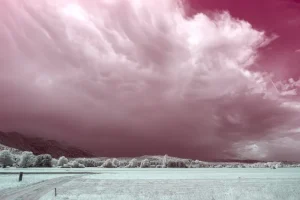
There is an even more practical explanation. When we look at a photograph, the brain does not process it only as an image. It also processes it as a possible memory. It tries to understand whether it belongs somewhere inside our personal archive of experiences. With a normal photograph, it can usually do this without much effort. It finds familiar references.
It places the image somewhere. It files it away. With an infrared photograph, that process becomes much harder. The colors do not match real memories. The quality of the light does not belong to everyday experience. The brain cannot easily say, “I’ve seen this before.” Because in a way, it never really has. And when the brain cannot place something in the past, that thing remains suspended in the present. Always present. Not dated. Not filed away. Not locked inside a drawer of memory. It stays open.
It keeps asking questions.
WHAT I LEARNED
It took me years to understand that this timeless quality of infrared photography was not a side effect of the technique. It was its greatest gift. We live surrounded by time. By what came before and what comes after. By what is already gone and what is still to come. Every image we create—every photograph, every video, every memory—is immediately placed on a timeline. The moment it exists, it begins to become the past. Infrared resists that process. Not completely. Not forever. But enough to create a different kind of space.
A space where things can exist without the constant pressure of time passing. And in that space, at least for me, the emotions I try to tell through my work find their truest form. Because the most important emotions—pain, loss, love, nostalgia—do not belong to one specific moment. They move through our lives. They change shape, but they never completely disappear. They return when we least expect them. To tell those stories properly, they need a light that does not grow old. And for me, that light has always been infrared.