
Why Should You Buy an Infrared Fine Art Print?
There are photographs that tell the story of a place, a moment, or a person.
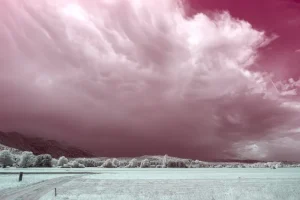 And then there are photographs that reveal something we simply cannot see.
Infrared photography belongs to this second category.
When we look at an infrared print, we are not seeing the world exactly as our eyes perceive it. We are looking at a different reality, recorded by the camera through a portion of the light spectrum that is normally invisible to us.
Perhaps this is the deepest reason for choosing an infrared print: because it means bringing into your home something that, at least in that particular form, does not exist within our everyday perception.
A piece of another world.
It Is Not Simply a Photograph
We live surrounded by images.
We see them on our phones, computers, social media, and in magazines. We constantly create them and consume even more. Most of these images exist in our attention for a few seconds and then disappear.
A fine art print, however, asks to be experienced differently. It has a physical presence. It occupies a space. It can be looked at today and then again ten, twenty, or thirty years from now. With infrared photography, this experience becomes even more unique because the image does not simply represent what is in front of our eyes.
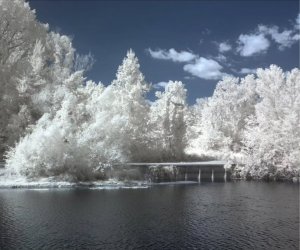
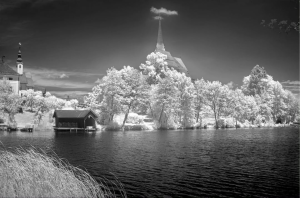
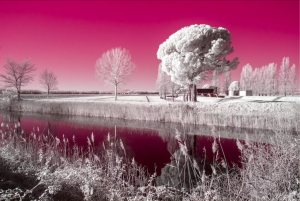
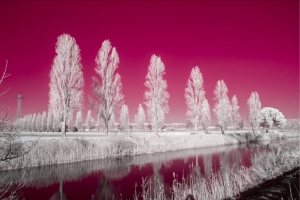 A tree that we see as green in reality may appear almost white. A sky can become deeply dark. Ordinary vegetation can take on an almost ethereal appearance. A familiar landscape can transform into something that seems to belong to a distant place, suspended somewhere between reality and imagination.
The photograph does not invent that world. It reveals it.
Bringing Home What the Eye Cannot See
Perhaps this is the most fascinating aspect of infrared photography.
When you purchase a print, you are not simply bringing home a photograph of a place. You are bringing home a different way of seeing that place. It is like preserving a fragment of a reality that truly exists, but normally remains hidden from our eyes.
A forest we may have walked through dozens of times can suddenly become an almost unreal landscape. A tree can take on a luminosity that it does not possess in everyday vision. A landscape can lose some of its familiarity and acquire a mysterious, silent, almost spiritual character.
In this sense, an infrared photograph can become something deeply personal. It is not simply an image to hang on a wall. It is a small window onto an invisible reality.
The Difference Between Seeing and Perceiving
Infrared photography begins with a very simple question: how much of what surrounds us remains invisible simply because our eyes are unable to perceive it? Infrared light is real. Vegetation reflects infrared radiation. A camera sensor can record it. Yet we cannot directly see it. The camera therefore becomes a kind of translator.
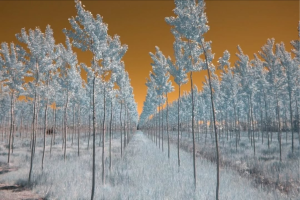 It does not replace reality; it interprets it through a portion of the spectrum that normally lies outside our visual experience. This is what makes every infrared photograph, in a sense, an image of a boundary. Between what we know and what we cannot see. Between the visible and the invisible.
Between the world we perceive and the world that exists beyond the limits of our perception.
Why a Print Rather Than Simply a Digital File?
A digital file can be perfect.
It can have extremely high resolution, be stored on multiple drives, and displayed on an extraordinary screen. But it remains an immaterial image. A print completely changes our relationship with the photograph. The photograph becomes tangible.
You can observe its surface, the depth of its blacks, the delicacy of its tonal transitions, and the texture of the paper. You can move closer and examine the details, or step back and experience the image as a whole. A fine art print is intended to be experienced over time, rather than consumed quickly like an image on a screen.
That is why the choice of materials is an integral part of the work itself. Fine art prints made on high-quality, acid-free papers are designed to provide excellent longevity when properly handled, stored, and displayed. The paper, the quality of the printing process, and proper conservation therefore become part of the artwork itself.
The goal is not to create something that lasts for only a few years. It is to create something that can continue to be experienced many years after it was purchased.
 A Photograph That Can Become Part of Your Story
There is another aspect that is often overlooked.
When we purchase a mass-produced object, we know that thousands or even millions of identical examples exist.
Fine art photography can be very different. Every print in my work is catalogued and numbered. Some works are produced as limited editions; in certain cases, an image is offered as a unique edition. This means that the number of people who can own that particular work is defined.
The numbering is not merely a formal detail. It is what physically connects that print to its history. The work in front of you is not simply “a photograph by Andrea Tomicich.” It is a specific print belonging to a particular edition, with a precise position within that edition.
And it is precisely this relationship between image, artist, edition, and provenance that transforms a print into a collectible work of art.
The Value of Time
There is another aspect that is worth considering. The value of an artwork does not necessarily remain fixed. Over the years, the way a work is perceived can change, its rarity can increase, and it can acquire greater significance within the artist’s overall body of work.
This does not mean that purchasing a photograph is a guaranteed financial investment. No artwork can offer such certainty. However, an original print—particularly one belonging to a limited or unique edition and accompanied by proper cataloguing and documentation of its provenance—possesses characteristics that may contribute to its future desirability among collectors. If an artist’s recognition grows, if a particular series becomes an important part of their artistic research, or if works from a specific period become increasingly rare, prints already held in private collections may acquire new significance.
In other words, when you purchase an art photograph, you are not only acquiring the value it has today. You are also acquiring the possibility that its story will continue to grow.
 You Are Not Buying a Decoration
This may be the most important distinction.
An art photograph should not be chosen simply because it “looks good above the sofa.” It can certainly become part of an interior, but its meaning should go beyond decoration. A meaningful artwork should continue to tell you something even after you have stopped looking at it.
It should change along with you. Sometimes it may remind you of a place. At other times, it may evoke a feeling. It may become associated with a moment in your life, a person, a journey, or simply a particular period of your existence. And this is where a physical photograph acquires a value that no digital file can replace.
It becomes part of your story.
A Fragment of an Invisible Reality
Perhaps, in the end, this is what purchasing an infrared photograph truly means.
Choosing to own an image of something we normally cannot see. A real landscape transformed by infrared light into a vision that belongs simultaneously to our world and to something that seems to exist beyond it. A print can remain on a wall for years. It can be looked at every day or rediscovered after a long time.
It can be passed on. It can become part of a collection. It can acquire a history of its own. And, above all, it can preserve for the future a vision of the world that exists only through that photograph.
That is why an infrared print is not simply a photograph. It is a fragment of an invisible reality. A piece of another world, brought into ours.
 Owning a Photograph Means Holding on to Time
We live in an age in which almost everything has become immaterial.
Photographs are stored on phones. Music lives in the cloud. Books are often digital. Memories are archived on servers and devices that are constantly replaced. A fine art print does exactly the opposite. It makes something physical again. It takes an image and, at least in part, removes it from the speed of the digital world.
It transforms it into something we can hold, preserve, and pass on. And when that photograph is an infrared image, the gesture becomes even more extraordinary: we are physically preserving the representation of a reality that our eyes alone could never see. Perhaps this is the real reason why an infrared print is worth owning.
Not simply to possess a beautiful image. But to possess something that reminds us that the world is far greater than what we are able to see.