
The false myth of photographic filters
When I hear people talk about “filters” in photography, especially when someone looks at my infrared images and asks “what filter did you use?”, I know that in most cases their mind goes straight to something digital. To an effect applied in a sophisticated photo retouch software, to a slight colour or contrast adjustment activated with a click. It’s become like that now: the word “filter” has been completely absorbed into the language of social media and post-production. A filter is something you apply afterwards, something you add.
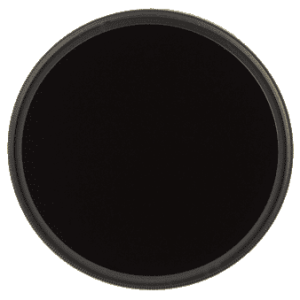
Yet, for those who work with light, a filter is a physical object. It is a piece of optical glass, often with specific coatings, that screws onto the front of the lens. It is something you touch with your hands, clean carefully, protect as you would a lens. My first infrared filter I bought with the same care I would have chosen a lens, and for the same reason: because it changes the light that enters the camera, radically altering the final result.
The difference is substantial: a digital filter adds something after the shot, a physical filter subtracts something before the shot takes place. It doesn’t modify what is already there, but decides what must reach the sensor.
In the case of infrared, the filter I use does not add any colour or effect. On the contrary, it blocks almost all visible light to allow the exclusive passage of infrared light. It’s as if I were telling the light: “What you see stops here. Only what you cannot see can pass through.” The filter doesn’t invent anything: it simply selects a portion of light that already exists, but that our eyes cannot perceive.
 But then, what infrared filters are?
And here we enter the most fascinating and profound detail of the photographic choice: not all infrared filters are the same. What I call “720nm” is different from an “850nm”, and the difference is not only technical but deeply artistic.
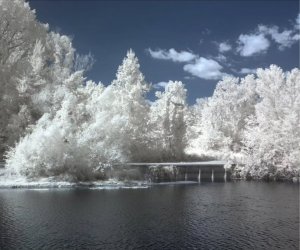
A 720nm filter is the most popular and versatile. It allows a small amount of visible red light to pass through, which allows the famous “false colours” we often associate with infrared photography to be created in post-production. The sky becomes dark blue, leaves white or pink, the whole dreamlike and recognizable. An 850nm filter, on the other hand, cuts almost all visible light, returning images in high-contrast black and white, drier, more dramatic. And there are filters with lower values, such as 550nm or 590nm, which produce more vibrant and surreal colours, skies that tend towards blue, vegetation that turns pink or intense red.
There is no one filter better than another. There is no “right” filter for infrared. There is the filter that best expresses your vision.
When I choose one filter over another, I am not making a technical choice. I am making an artistic choice. The 850nm filter returns a more severe image, more sculptural, almost metaphysical. The 720nm is softer, more accessible, but also richer in chromatic possibilities. They are not equivalent alternatives: they are different languages. And the language I choose is closely linked to what I want to communicate, the mood I want to evoke, the relationship I want to establish between the subject and the viewer.
The IR filter is not a lab trick. It is my brush. It is the pencil stroke I decide to use before I even start drawing. And just as a painter chooses between oil and watercolour not out of fashion, but out of expressive necessity, I choose between one filter and another to give form to what I saw before even shooting.
That is why, when I hear “infrared is a Photoshop filter”, I smile. Because I know that behind every one of my images there is a piece of glass, a conscious choice, and a light that already existed but that only that choice allowed to reveal.