
How An Infrared Photography Project Is Born
When people ask me how a photography project comes to life, they expect me to talk about lights, lenses, locations. About technique. But the answer I usually give them surprises them.
A project is born in my head. And it stays there for a long time, before I even touch my camera.
THE MOMENT IT ALL STARTS
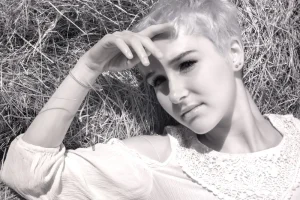
I have never rationally chosen to start a photography project. I have never woken up one morning thinking — today I’ll decide to work on a new theme. That’s not how it works, at least for me.
The starting point is always an event. Something that happened to me. Something I saw happening to someone close to me. A precise moment, sometimes painful, sometimes uncomfortable, that I just can’t let go of.
*The Weight of the Unsaid*, for example, was born like that. From an awareness that hit me like a punch — that moment when you realize you can’t apologize to someone anymore because that person is gone. It’s not grief in the usual sense. It’s something more specific, sharper. A door closed forever on something that was never resolved. When I felt that sensation, or when I saw it in the eyes of someone telling me their own story, I knew I had to turn it into a project. I didn’t know how yet. But I knew I couldn’t just leave it there without giving it a shape.
THE REFLECTION: THE WORK YOU DON’T SEE
After the initial event comes the longest part. The part you don’t see, that doesn’t produce any images yet, that sometimes lasts for months.
I stop and think. And when I say think, I don’t mean I mull it over every now and then. I mean I let that thing work inside me, sometimes consciously, sometimes not. I carry everything I have with me — my knowledge of philosophy, the things I’ve read, my experiences, the questions I’ve always asked myself about human beings and the mechanisms that drive them.
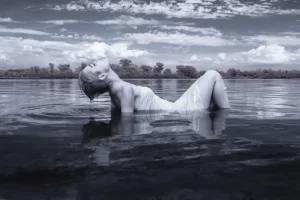
I start asking myself why. Why certain psychological mechanisms exist. What triggers them. What they do to the people going through them. Whether what I lived or observed is an isolated experience or something universal — something that anyone, sooner or later, might recognize as their own.
It’s at this stage that a photography project, for me, stops being personal and becomes something bigger. It stops telling my story and starts looking for everyone’s story.
THE IMAGES THAT COME ON THEIR OWN
At some point, without me forcing them, the images start to form.
It’s not a rational process. I don’t sit down at a desk with a blank sheet of paper trying to plan the photos one by one. The images just come. Slowly, sometimes one at a time, sometimes in small groups. As if the reflection I had left to work in silence had finally found a visual shape by itself.
At first they’re vague. An atmosphere, a quality of light, a feeling. Then gradually they become more precise. A gesture. A posture. A face with a certain expression. A space with a certain light.
I never force this process. I’ve learned over time that forcing it doesn’t help — it produces technically correct but empty images. The images that stay with you, the ones that years later I still look at and feel still have something to say, are always the ones that came on their own, when they were ready.
When I have the whole project in my mind — all the images, the sequence, the overall meaning — I know it’s time to move to the next stage.
THE SUBJECT: NOT JUST ANYONE
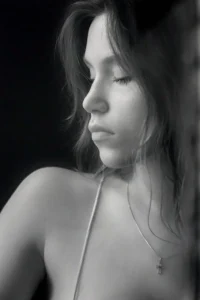
Here, many photographers make a different choice than I do. I don’t look for the most beautiful subject, or the most photogenic one, or the most available one.
I look for someone who understands. Someone who feels the project — not just intellectually, but deep down, almost intimately. Someone who, when I explain what it’s about, doesn’t nod politely but stays quiet for a few seconds, like they’re searching for something inside themselves.
That pause is worth more than any modeling portfolio. And one thing I’ve always preferred is to use non-professional subjects — people with little or no experience posing. I always look for spontaneity in the people I photograph, along with the excitement of a first time.
Because in front of the camera, everything shows. You can see if someone is there just to take pretty pictures, or if they’re there because the message really reached them. And the difference in the final image is huge. It’s not about skill or experience in front of the camera. It’s about empathy with what you’re trying to tell.
With some projects I’ve been lucky enough to find the right person right away. With others I’ve waited. Because I prefer to wait rather than compromise something I’ve built with months of reflection.
THE SHOOT: THE LAST PART, THE EASIEST
When I finally get to the shoot, the hardest part has been over for a long time.
I don’t take thousands of photos. I’ve never had that habit and I can’t really understand it. For me, shooting hundreds of versions of the same image hoping one turns out well just means you still don’t know what you’re looking for.
I arrive on set with the images already in my head. I already know, more or less, what I want to get. The work on site is finding the right light, finding the right moment, finding that fraction of a second when everything I’ve thought about for months comes together in a real image.
I shoot what is necessary. No more. Every frame is a conscious choice, not a statistical bet.
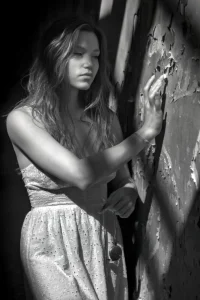
This doesn’t mean there are no surprises — actually, there are always surprises, and they’re almost always welcome. Sometimes the subject does something unexpected that’s better than what I had imagined. Sometimes the light does something I didn’t predict and it completely changes the quality of an image. But these surprises come from a solid foundation, from a clear idea. They’re not just random luck.
WHY INFRARED AND NOT SOMETHING ELSE
One thing I’m often asked is why all these projects are done in infrared. Could you tell the same stories with regular photography?
The short answer is no. Or at least — not in the same way.
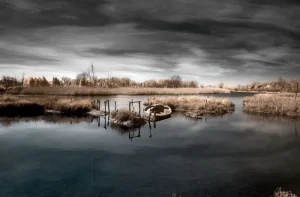
Infrared brings a visual quality that fits perfectly with the themes I care about. Suspended time. Visceral intimacy. The feeling that what we’re looking at exists in a space halfway between reality and memory. That light that reveals what normally stays hidden — the veins, the fragility of skin, the depth of the eyes — is the same light I need to talk about invisible things. About unspoken emotions. About psychological mechanisms that exist but that we don’t know how to show.
It’s not an aesthetic choice. It’s a choice of consistency between the language and the message.
WHAT REMAINS
When a project is finished — when the photos are printed, exhibited, shared — something always remains.
It’s not satisfaction, or at least not just that. It’s something closer to a kind of quietness. As if that thing that had struck me at the beginning, that event I couldn’t let go of, had finally found a place to be.
It doesn’t disappear. But it doesn’t weigh the same way anymore. And I need to rest. Not because developing the project from start to finish was such a huge effort, but because in the end it involves me emotionally — precisely because I prepare and develop what is the medicine for the project’s theme.
Maybe this, in the end, is why I do photography projects. Not to show something to the world — although I hope that what I show reaches someone. But to give shape to what would otherwise remain shapeless. To give a visual name to things that words, on their own, cannot hold.
And infrared, with its invisible light, is still the most honest language I know to do that.