
Why does infrared photography cause disorientation?
There’s a precise moment, in front of an infrared photograph, when the brain gets stuck.
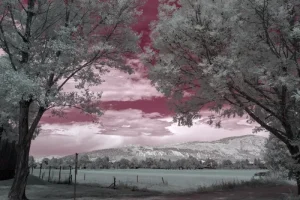
It’s not immediate. First you look. You recognize something — a tree, a face, a landscape. The brain starts, as it always does, to classify what it sees. And then it stops. Because something isn’t right. The sky is golden. The vegetation is blue. The skin has a shade you’ve never seen on any living human being.
It’s not ugly. It’s not beautiful. It’s just… wrong. And yet you can’t stop looking.
This disorientation is not a side effect of infrared photography. For me, it’s the heart of everything.
THE BRAIN WANTS TO CLASSIFY
Our brain is an extraordinary machine. In a few milliseconds it can recognize a face, read a landscape, understand if something is a danger or a resource. It does this by constantly comparing what it sees with a huge archive of experiences accumulated over a lifetime.
The sky is blue. Grass is green. Skin has certain colors. These aren’t opinions — they’re certainties built from years of observing the real world.
Then comes an infrared photograph with a red-blue channel swap. And the whole archive goes haywire.
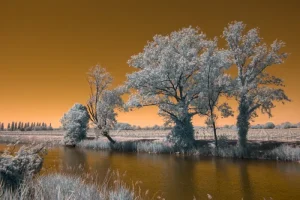
The brain recognizes the structure — that’s a person, that’s a forest, that’s a sky with clouds. But the colors don’t match any real experience stored in memory. It’s not like looking at an abstract painting, where the brain immediately accepts that it’s not reality. No — here the structure is photographic, realistic, precise. Only the colors are “wrong.” And it’s exactly this combination that creates the short circuit.
NEAR INFRARED AND THE CHANNEL SWAP
With filters below 720nm — the ones used in so-called near infrared — some visible light still reaches the sensor along with the infrared. The result is a raw file full of particular color information, dominated by the red channel.
The swap, meaning swapping the red channel with the blue one, doesn’t invent anything. It works with information already present in the file. But the visual result is what creates more disorientation than any other infrared processing.
Because the sky, which in raw infrared appears reddish, becomes blue after the swap — and so far the brain is happy, it knows blue sky. But vegetation, which in infrared reflects a lot and after the swap takes on yellow, golden or even white tones, doesn’t match any real memory. And the skin, with its particular shades, finds itself in territory the brain doesn’t know how to handle.
The result is an image that almost feels like remembering something. A dream, maybe. Or a distant, slightly distorted memory. Something familiar that you can’t quite place.
RECOGNIZABLE BUT IMPOSSIBLE
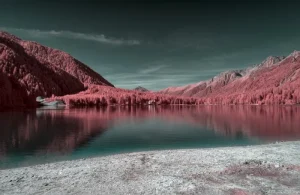
This is the paradox I find most fascinating.
If I showed a completely abstract landscape, or an extreme digital manipulation, the brain would give up right away and accept that it’s something invented. There’s no disorientation, just distance.
But infrared photography — especially near infrared with a channel swap — doesn’t give you this way out. The subject is real and recognizable. The composition is photographic. The light has a concrete, not artificial quality. And yet the colors belong to a world that doesn’t exist in your visual memory.
It’s recognizable but impossible. Real but never seen. And it’s precisely this tension that keeps the gaze stuck on the image longer than usual.
DISORIENTATION AS A TOOL
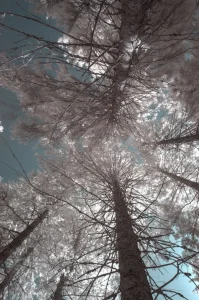
Over the years I’ve realized that this disorientation isn’t a problem to solve. It’s a tool.
When a person stops in front of one of my photographs and can’t immediately decide what they think, in that moment they are open. They haven’t classified yet, they haven’t archived yet, they haven’t decided yet. They are in a state of pure attention, which in everyday life is extremely rare.
And it’s in that moment that an image can truly say something.
I don’t know if this applies to every photographer who works with infrared. For me it does. I look for that moment of uncertainty. That fraction of a second when the observer’s brain stops and asks itself: what am I looking at?
Because in that question, everything is already there. There’s curiosity, there’s openness, there’s a willingness to see the world differently than you’ve always seen it.
And maybe that’s exactly why I keep shooting with a light that no one can see.