
The meaning of the invisible in my photography
There Are Things I Can’t Explain Rationally. And After More Than Twenty Years of Infrared Photography, I’ve Stopped Trying.
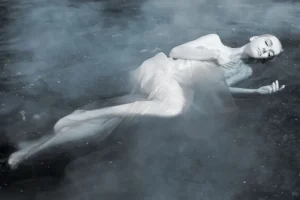
I know infrared light physically exists. I know how the sensor works. I know what a channel swap does and why certain wavelengths give certain results. I know the technical side well. But there’s something that happens when I shoot in infrared that goes beyond the technique. Something I’ve never found in any other type of photography. I don’t know what to call it except with a word I already know will raise some eyebrows: mystical.
A LIGHT THAT GOES WHERE EYES DON’T REACH
When I photograph a person in infrared, the skin changes. It becomes light, almost like marble. Surface imperfections disappear. And in their place, other things emerge — details we don’t normally see, things we don’t normally show. Veins, especially.
The first time I saw a person’s veins clearly emerge in an infrared photo, I stopped. It wasn’t an aesthetic effect. It was something bigger. I was looking inside. Not metaphorically — physically. That thin blue network that runs through the human body, invisible in everyday life, was suddenly there. Real. Fragile. Intimate.
It’s hard to explain what you feel in that moment without sounding like you’re exaggerating. But for me, it’s as if the camera went past the surface and entered the person’s body. Not in a medical sense, not like an X-ray. In an emotional sense. As if for a moment I had managed to touch something that normally stays hidden — not just under the skin, but inside the person themselves.
Of course I don’t believe a camera can photograph a soul. I know that’s impossible. And yet every time I look at certain infrared portraits, I get this feeling that something intimate and ethereal has come out into the open. Something that person carries with them every day without showing anyone.
Maybe it’s just a suggestion. But after twenty years, I still feel it. And that’s enough for me.
THE INVISIBLE AS A PHILOSOPHICAL LANGUAGE
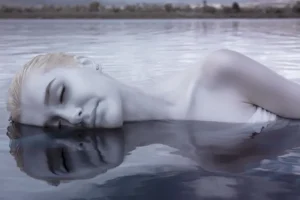
I’ve never used infrared just to take beautiful photos. Or rather — I hope the photos are beautiful, but that’s not the starting point. The starting point is always a question. A reflection. Something I feel the need to tell, that ordinary visible language can’t contain.
The invisible, for me, is the perfect language to talk about everything in life that you don’t see but feel deeply. The things left unsaid. Broken bonds. Time passing without us noticing. The fragility of existing.
These are real things. They really exist. But you can’t touch them or photograph them with normal light. So I use a light that eyes can’t see to talk about things the heart feels but can’t show.
THE PROJECTS: WHEN THE INVISIBLE BECOMES A STORY
Every one of my photography projects starts from the same point — a philosophical or social reflection that needs infrared to exist visually.
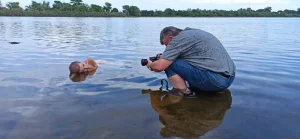
Il peso del non detto (The Weight of the Unsaid) is probably the project where you feel this the most. It’s about a moment many people know but no one wants to name: when you realize you can never apologize to someone because that person is no longer there. There’s no more time. There’s no more possibility. All that remains is the weight of something that wasn’t said, and now can never be said. I tried to show the stages of this realization — not grief in the classic sense, but that specific, sharp awareness that arrives when it’s too late. Infrared, with its suspended, timeless quality, was the only visual language I felt could contain all of this.
Le lacrime del legno (The Tears of Wood) tells instead about what remains after humans have passed through. When a person is gone, nature doesn’t wait. It takes everything back, slowly, inexorably. Walls crack. Branches grow where they shouldn’t. Silence returns to fill the spaces. I’ve always found something deeply poetic in this process — not sad, actually almost comforting. Nature doesn’t judge. It doesn’t remember. It simply moves forward. And infrared, which turns green into white and sky into black, manages to show this process with a visual quality that already feels like memory, already like distance, already like time that has passed.
What Your Eyes See Not is the project where I tried to tell the whole arc — from birth to death. Not in a didactic way, not with obvious symbols. But through images that evoke the different seasons of human existence. Infrared here works with light in an almost biological way — it transforms bodies, landscapes, atmospheres into something that seems outside of time, suspended between a before and an after that we can never see clearly when we’re inside our own lives.
WHAT I LOOK FOR EVERY TIME I SHOOT
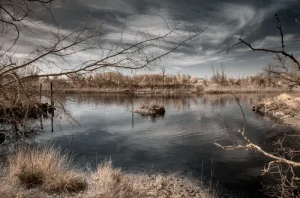
I don’t have a definitive answer to what exactly I’m looking for when I do infrared photography. I know I’m looking for something. A hidden truth, maybe. An emotion that doesn’t yet know it exists. That moment when a person, a tree, a landscape stops being simply itself and becomes something else — presence, fragility, memory.
Infrared lets me enter a territory that normal photography can’t reach. Not because it’s a better technique. But because it uses a light that doesn’t belong to the everyday world. A light we haven’t learned to defend ourselves against. One that arrives before the brain has time to build its barriers.
And maybe that’s exactly why sometimes it manages to touch something real.
I don’t know if what I photograph is truly the soul of things. Probably not. But I know that when one of these photos turns out well, when I feel it has captured something I couldn’t have expressed in any other way, I feel something I can’t explain rationally.
And after more than twenty years, like I said at the start, I’ve stopped trying.