
How the human face changes in infrared
There’s a moment, the first time you photograph a person in infrared, when you stop. Not because of a technical problem. Not because something went wrong. You stop because what appears on the screen is something you’ve never seen before. And yet it’s a real person, flesh and blood, who was right there in front of the lens a second earlier.
After more than twenty years I still have that same feeling. It fades, but it never completely goes away. And it’s probably why I keep photographing people in infrared.
SKIN: WHEN THE SURFACE DISAPPEARS
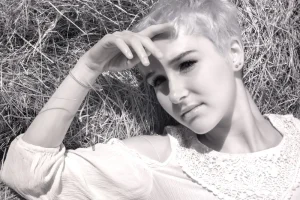
The first thing that changes, and the most obvious, is the skin.
In infrared, the skin becomes light. Sometimes very light, almost luminous, almost like marble. Surface imperfections — spots, redness, small unevenness in complexion — tend to disappear or fade significantly. What remains is a smoother, cleaner surface, in a certain sense more essential.
But it’s not an artificial cleanliness, like the one you get from digital retouching. It’s different. It has a particular quality — infrared skin doesn’t look retouched, it looks translucent. As if light goes through it instead of bouncing off it.
This happens because infrared light penetrates slightly into the surface layers of the skin and is reflected differently than visible light. The result is that characteristic brightness that anyone who knows infrared recognizes immediately.
VEINS: GOING INSIDE
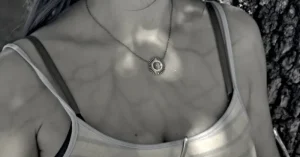
Then there are the veins.
They don’t always show up with the same intensity — it depends on the person, the wavelength used, the available light. But when they appear, they completely change the meaning of the image.
Veins are something we don’t normally show. They’re there, under the skin, invisible in most everyday situations. And yet they exist, they run through the whole body, they carry life. In infrared they become visible — thin dark traces running across the temples, the neck, the hands, the chest.
The first time I saw a person’s veins clearly appear in an infrared portrait I had a precise feeling: I was going inside. Not in a medical sense. In an emotional sense. As if the camera had gone through the surface and reached something more intimate, more fragile, more real.
For me, veins in infrared are not an aesthetic detail. They are the physical sign of something that normally stays hidden. And every time they appear in a portrait I feel that image has reached a level of intimacy that few other photographs can touch.
EYES: DEPTH YOU DON’T EXPECT

Eyes in infrared are a chapter of their own.
They change in less predictable ways than the skin. It depends a lot on the iris color, the light, the wavelength used. But in general they tend to become deeper, darker, more intense. Sometimes the iris darkens until it almost blends with the pupil, creating a look that is almost hypnotic, almost unsettling.
In other cases though — especially with certain light eye colors and certain wavelengths — the iris takes on a particular, almost crystalline transparency. As if the eyes suddenly became bigger, more present, harder to hold.
I can’t rationally explain why infrared eyes have this effect on the viewer. I only know that when I show an infrared portrait, it’s almost always on the eyes that the gaze stops last. And stays there.
HAIR: THE COLOR SURPRISE
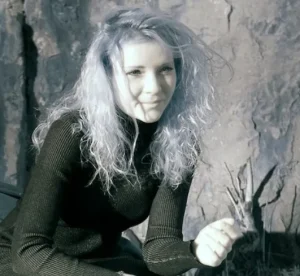
Hair in infrared often holds surprises. And the biggest surprise is about dyed hair.
Natural hair tends to darken in infrared, especially dark hair, which can become almost black with a very strong contrast against the light skin. White or gray hair on the other hand reflects a lot of infrared and becomes very bright, almost incandescent.
But the most unexpected thing, the one that never stops surprising me, is certain dyed hair — especially those with cool artificial colors, ash tones, particular blondes, certain treated browns. In infrared, this hair can shift towards completely unexpected shades. Turquoise. Aqua green. Metallic blue.
It’s not an effect added in post-production. It’s the chemical response of the artificial color molecules to infrared light. Some dyes reflect infrared completely differently than natural hair pigments, and the visual result can be surprising — sometimes beautiful, sometimes strange, always interesting.
It’s one of those moments when infrared reveals something you didn’t expect. Something that was there, invisible, hidden in a chemistry that your eyes couldn’t read.
THE BODY AS A WHOLE: A DIFFERENT PRESENCE
Taken as a whole, the human body in infrared takes on a quality that I can’t describe otherwise than as presence.
It’s no longer just a photographic subject. It becomes something denser, more layered. The luminous skin, the visible veins, the deep eyes, the hair behaving unexpectedly — all of this together creates a portrait that seems to contain more information than a normal portrait. As if infrared has added a layer of reading that isn’t normally available.
Sometimes I look at certain infrared portraits and think they look like something halfway between a photograph and a memory. They have that slightly dreamlike, slightly out-of-time quality that memories have when you recall them after years. Recognizable but not quite present. Real but already distant.
Maybe that’s why I find them so suitable for telling stories about intimacy, fragility, the passage of time. Like in my projects — where the human body is never just a body, but always the visible container of something invisible.
Another very interesting aspect is clothing. Clothes also behave in completely unpredictable ways when seen in infrared. Many clothes that look black to the human eye can appear completely white in infrared. This is one of the reasons why I prefer to photograph all the clothes that will be used in a project before shooting the project itself. To have full control of the resulting image, you need to know how the clothing behaves, which, as I said before, is not predictable in advance.
EVERY PERSON IS A DISCOVERY
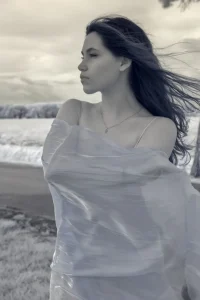
One thing I’ve learned in all these years is that no two people react to infrared light the same way.
Every skin is different. Every bone structure creates different shadows. Every eye color responds differently. Every hair — natural or dyed — carries its own chemistry, its own behavior, its own surprise.
And maybe it’s this unpredictability that fascinates me most about the infrared portrait. After more than twenty years I already know, more or less, what to expect from a landscape. But in front of a new person, I never really know. There’s always something that emerges that I didn’t expect.
And that unexpected thing, almost always, is the most beautiful thing in the whole photograph.