
Infrared does not invent images
One of the most common things people say about infrared photography is:
“Yes, but the computer creates everything afterward.”

Or:
“They look like special effects.”
In reality, infrared photography does not invent anything. The camera is truly recording a part of light that physically exists but cannot be seen by human eyes. And this is important to explain, because many people believe infrared images are simply normal photographs heavily manipulated in post production. But this is not true.
Infrared Light Is Real
Infrared light truly exists. It is part of the light spectrum invisible to human vision but constantly present around us.
The sun emits infrared radiation.
Plants reflect infrared light.
Even the human body produces infrared heat.
An infrared-modified camera simply records this invisible light.
So when we see:
-
white trees;
-
dark skies;
-
surreal landscapes;
we are not looking at fake computer-generated effects. We are observing the real behavior of infrared light.
Why Do Infrared Images Sometimes Have Strange Colors?
This is where confusion often begins. Some infrared photographs contain unusual colors:
-
golden skies;
-
blue vegetation;
-
red or purple tones.
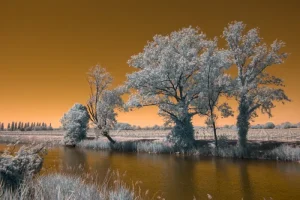
Many people assume these colors are completely artificial. In reality, they come directly from the way the camera sensor records infrared light. Especially with infrared filters below 720nm, part of the visible spectrum still reaches the sensor together with infrared light. This creates very unusual color information.
Channel Swap: The Classic Infrared Editing Technique
One of the most common infrared editing techniques is the so-called “channel swap,” which means swapping the Red and Blue channels. This process is mainly used to create more balanced or visually natural colors.
For example:
-
skies can become blue again;
-
vegetation may appear bright or golden;
-
the image becomes easier to interpret visually.
It is important to understand something: this editing process does not invent elements that do not exist.
It does not add objects.
It does not alter the composition.
It does not create fake scenes.
It simply reorganizes the color information already present in the original infrared file.
Why Is Channel Swap Mainly Used Below 720nm?
Infrared filters are not all the same.
Filters such as:
-
550nm;
-
590nm;
-
650nm;
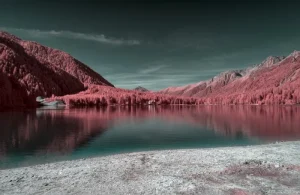
still allow part of visible light to reach the sensor together with infrared light.
Because of this, the image still contains usable color information that can be processed through channel swapping.
With stronger filters such as:
-
720nm;
-
850nm;
-
950nm;
the visible light component becomes extremely small or almost disappears completely.
As a result:
-
colors become very limited;
-
images naturally become monochromatic;
-
channel swapping loses most of its purpose.
This is why infrared photographs shot above 720nm are often converted directly into black and white.
Post Processing Is Usually Minimal
Many people imagine infrared photography requires complex special effects. In reality, the editing process is often very simple.
Most infrared workflows mainly involve:
-
white balance adjustment;
-
contrast correction;
-
black and white conversion;
-
optional channel swapping.
The real transformation happens before editing: inside the light itself.
Reality already changes appearance when observed through infrared wavelengths.
Why Is This Important?
For me, this is important because infrared photography is not about creating digital illusions. It is about revealing an invisible part of reality. Infrared reminds us that the world is far more complex than what human vision can normally perceive. And this is exactly why I use infrared photography as an artistic and philosophical language.
I quit this article with the title citation: Infrared photography does not invent images.
It records real invisible light. Even classic infrared editing techniques such as channel swapping do not create artificial worlds: they simply reinterpret the color information already contained in the original infrared file. The true uniqueness of infrared photography is not the computer. It is the invisible light surrounding us every day.