
Visible vs. Infrared: Two Realities of the Same Place
They Aren’t Two Different Worlds. It’s the Same World. You Just Can’t See It. When you look at an infrared photo and compare it to a normal photo of the same scene, it almost feels like you’re looking at two different worlds. But the place is exactly the same.

Every now and then, when someone asks me to explain infrared, I take two photos taken in the same spot, at the same moment, and put them side by side. One is what their eyes would see. The other is what my camera saw. The result is always the same: the person stays quiet for a few seconds. Then they say, “But this is a special effect, right?”
No. It’s not.
Same landscape. Same light. Same moment.
What changes is the way reality is being observed. And right here is where one of the most fascinating aspects of infrared photography comes from.
OUR EYES ONLY SEE A SMALL PART OF REALITY
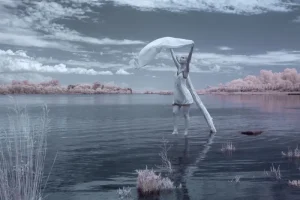
The first time I seriously tried digital infrared was at the Miramare Castle park, here in Trieste. I had just converted an old camera to full spectrum by myself. I didn’t really know what to expect. I remember pointing it at a pot with a palm tree, sky in the background. I used an 850nm filter.
When I got home and opened the file on my computer, I just stood there for a few seconds. The palm tree had turned pure white and the sky was completely black. I hadn’t done anything. Just a white balance adjustment. No effects, no Photoshop, no channel swapping. It was there. Real. Invisible just a moment before.
I’ve never forgotten that photo. The camera isn’t inventing a new scene. It’s just showing information we normally can’t perceive.
THE SAME PLACE CAN LOOK COMPLETELY DIFFERENT
When you look at a landscape with your own eyes, you see what your eyes can see. That sounds like a dumb thing to say, but it’s the truth. The sky is blue. Leaves are green. Skin is pinkish or some familiar color. The world looks exactly the way we’re used to seeing it.
But with infrared, everything changes:
– Trees turn white
– The sky gets dark
– Skin looks different
– Light feels softer and unreal
– The landscape seems frozen in time
And yet the place is the same. The light is the same. The moment is the same. Nothing has been artificially altered. It’s just a different slice of light.
NOT ONE FILTER, BUT MANY
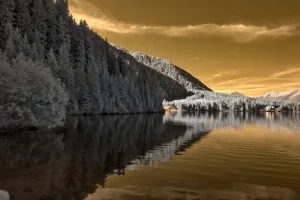
This is where a lot of people get lost. Because there’s no such thing as “one” infrared. There are many, depending on the filter you put on your lens. Over the years, I’ve collected quite a few: 550nm, 580nm, 620nm, 680nm, 720nm, 790nm, 850nm, 950nm. Each one gives back a different version of reality.
The “lighter” filters, like 550nm and 590nm, still let in a lot of visible light along with the infrared. The result is images full of color: golden skies, blue or purple vegetation, warm tones that look like they came out of a dream.
As you go up in wavelength, the visible part decreases. At 720nm, you’re already in a middle ground: color is still there, but it’s soft, suspended. For me, this is the most versatile filter, the one I use most often. It lets me decide later, in post-processing, whether to go for black and white or keep a slight tint.
Then you get to 850nm and 950nm. Here, visible light is almost completely gone. What you get is pure monochrome, deep contrasts, black shadows and very white highlights. It’s the most “bare bones” and most fascinating version of infrared. For certain subjects, especially landscapes, it’s my favorite.
Lately, I’ve rediscovered the lower filters, 550 and 590, just to play around with color. It’s a less serious approach, more free. Sometimes I need that.
TWO REALITIES THAT EXIST AT THE SAME TIME
The most surprising thing is that both images are real. The visible photo and the infrared photo show the exact same moment.
This reminds us of something really important: reality doesn’t just depend on what we can see.
There are invisible aspects of the world that keep on existing even when our eyes can’t perceive them. And that’s exactly what makes infrared so fascinating from an artistic and philosophical point of view.
WHY I ALMOST NEVER SHOW THE “BEFORE AND AFTER”
This might surprise you. In exhibitions or presentations of infrared photos, I’ve almost always avoided putting the normal photo and the infrared photo of the same subject side by side.
Let me explain: when you give someone a gift, you don’t put it in a clear plastic bag. They already know what’s inside. There’s no surprise, no magic.
For me, infrared works the same way. If I show what things look like “normally” first, then the infrared version loses some of its charm. It just becomes “the weird version.” But if I show it on its own, without comparison, people stop, they wonder, sometimes they feel something without knowing why. Then, if they’re curious, I explain it to them. But only after.
AND THE CRITICISM? IT ALWAYS COMES
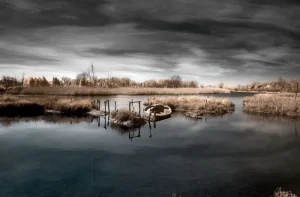
The most common reaction when I show these photos is: “Nice effect, did you do that with some software?”
I try to explain. Those who get it are fascinated. Those who don’t, remain in disbelief. They keep thinking I’m selling them smoke, that infrared is just some computer editing disguised as a special technique.
The model was there. The tree was there. The church was there. What they call an “effect” is simply invisible light that already existed at the moment I pressed the shutter. It’s a kind of magic. And to enter this world, you don’t need fairy dust or happy thoughts. You just need an open mind.
THE PARADOX OF REALITY BEING “TOO REAL”
Here’s something curious I’ve noticed over the years.
Sometimes the criticism I get isn’t that the infrared photo is too strange. It’s the exact opposite. If the photo has a recognizable subject – a person, a church, a tree – people recognize it right away. And precisely because of that, they think, “Oh, that’s that place. So he added the weird colors later.”
They don’t understand that precisely because the subject is real, the invisible light is even more fascinating. I didn’t pick some abstract landscape. I picked a place that exists, that maybe they know, and I showed it under a light their eyes can’t see. It’s a paradox: the more recognizable the photo is, the harder it is for some people to believe it’s not a trick.
WHAT I’VE LEARNED IN OVER 20 YEARS
After more than twenty years, by now when I shoot infrared I already know, more or less, what I’ll get. I’m not off by much. But every now and then, reality still surprises me in a good way. A cloud that turns out spectacular. A vein that shows up where I wasn’t expecting it.
I’ve exhibited these photos in New York for several years in a row, up until today. In Trieste, in various exhibitions. In Venice.
And even today, when an infrared photo comes out well, I feel something strong. Serenity. Peace. Like in that moment, for an instant, I managed to see something I shouldn’t be able to see.
Maybe that’s why I keep doing it.
INFRARED AS AN ARTISTIC LANGUAGE
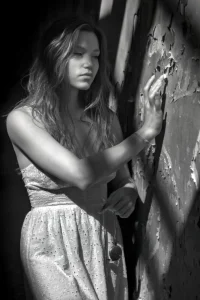
I don’t use infrared photography just to create “weird” or spectacular images. I use it because I’m interested in the concept of the invisible. The comparison between visible and infrared becomes a reflection on reality itself.
How much of the world are we missing? How much of what we consider real depends only on the limits of our senses? Infrared photography doesn’t provide answers. But it invites us to look at the world in a different way.
A visible photo and an infrared photo show the same place but two different realities of light. Neither one is fake. They’re just two different ways of observing what’s around us. And maybe that’s the deepest appeal of infrared photography: reminding us that the world is much bigger than what we can see.
THE ONLY QUESTION THAT MATTERS
In the end, infrared photography doesn’t give answers. But it forces me to ask myself a question I wouldn’t otherwise ask: how much of the world am I missing, simply because my eyes aren’t big enough?
I don’t know if there’s an answer. But in the meantime, I keep shooting.