
Why do trees turn white in infrared?
One of the most surprising things about infrared photography is the appearance of trees.
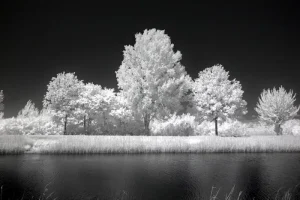
Leaves look like snow.
Grass becomes extremely bright.
Vegetation almost seems to glow.
The first time I really tried infrared photography was at Miramare Castle Park, here in Trieste. I had just modified an old camera myself to full spectrum. I didn’t really know what to expect.
I remember pointing it at a pot with a palm tree, sky in the background. I used an 850nm filter. When I looked at the screen, I stood there for a few seconds. The palm tree was completely white. Not light gray, not some filter effect. White, as if someone had dusted it with snow on a sunny day.
I immediately thought it was a mistake, a problem with the camera modification. But no: I had just found out, out in the field, that trees in infrared really look like that.
It’s not an Instagram filter, it’s not Photoshop. The explanation is simple physics: leaves reflect a huge amount of infrared light because their inner structure (especially the mesophyll) is made to send those wavelengths back, while they absorb visible light for photosynthesis. We can’t see that light, but the camera can. And since the infrared image at those frequencies comes out in white tones, plants become very bright.
THE WOOD EFFECT AND THAT CONTRAST YOU DON’T EXPECT
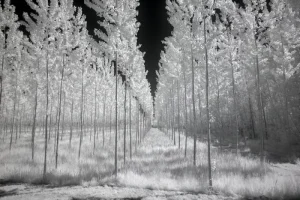
Over the years I learned that this phenomenon has a name: the Wood effect, after Robert W. Wood, a physicist from the early 1900s who studied the invisible with almost handmade methods. What surprises people who ask me “is it real or fake?” is not just the white trees, but the contrast with the sky.
Because the sky, in infrared at 720nm or higher, turns dark, sometimes black. Air doesn’t reflect much infrared, in fact it scatters very little of it. Meanwhile, an oak leaf in full sun can reflect up to 50–60% of the infrared it receives. The result is a landscape that doesn’t exist for our eyes but is perfectly real: trees that look lit from within, a dramatic sky, grass that turns silver.
As a photographer, I don’t look for weirdness just for the sake of it. I look for what we can’t normally see. And every time I frame a forest in infrared, I know the camera isn’t making anything up. It’s just translating something that was already there, quietly.
WHY I STILL USE INFRARED AFTER ALL THESE YEARS
If I had to say what keeps me here with these converted cameras and this unusual technique, it’s not just the science. It’s a specific feeling: when I look at a white tree in infrared, I know that white isn’t a trick, but a parallel truth. Reality is bigger than what our eyes can capture. And infrared photography reminds me of that every time. I never wanted to make “surreal” photos at all costs.
I started out of technical curiosity back in 2009, and I keep going because every shot gives me back a world that feels familiar but never the same as itself. Trees don’t actually turn white: we see them white because we are finally looking at a part of light we have always ignored. And for me, that’s the reason these images still fascinate me so deeply.