
Infrared photography is not black and white Photography
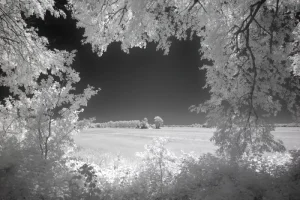
One of the most common things people say when they see an infrared photograph is:
“What a beautiful black and white image!”
And every time, I have to explain the same thing. No, most of the time it’s not just a black and white photo. It’s a photo taken with a type of light that the human eye can’t see.
And that difference, for me, is huge.
What is infrared really?
Our eyes only see a tiny slice of the light that’s out there, what we call the visible spectrum. Infrared sits just beyond red, and for us it’s completely invisible. But it’s everywhere. The sun gives it off, plants reflect it, even our own bodies give it off as heat. I have a camera that I personally modified to full spectrum, and when I put an IR filter in front of it (usually 850nm or 720nm) that camera starts seeing what my eyes can’t.
And here’s the thing: the scene I see in the viewfinder really exists. It’s not a Photoshop effect, it’s not an artistic filter. It’s just a piece of reality we usually ignore.
But then why does it look like black and white?

That’s true: a lot of my infrared photos do look like black and white. But that’s not the point. The point is that the original image, the one that comes out of the camera, contains completely different information compared to a normal photo. Black and white is just a final choice, a choice that depends on the filter, an aesthetic choice. What matters is what the camera saw.
It depends on which filter I use. If I use an 850nm, the image is already pretty much black and white to begin with, with a really strong contrast. If I use a 720nm, on the other hand, a little bit of visible red still gets through, and I can do some special color things with it (the famous “false color” effect). But the substance doesn’t change: trees turn white or very light, the sky turns dark, sometimes black, grass looks like silver, people’s skin changes its appearance.
It’s not that the camera is wrong. It’s that every material reflects infrared differently. Take an oak leaf, for example: it reflects over 50% of the infrared it receives. Air, on the other hand, reflects very little of it. The result is a contrast that just doesn’t exist in visible light.
Infrared doesn’t invent another world
This is one of those beliefs that dies hard: that infrared is some kind of trick, a digital effect, an imaginary world. But no. Infrared light is real. Period. If you don’t believe me, think about remote controls, night vision devices, thermal cameras. All stuff that uses infrared. I’m doing the same thing, but with a camera and an artistic idea behind it.
I’m not making anything up. I’m just translating the invisible into something that my eyes – and yours – can finally see. There are many realities out there. You just need to know how to look at them.
Why do I use infrared?
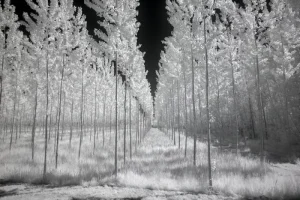
I don’t do it because I’m looking for weirdness at all costs. I do it because it taught me something that no other type of photography had shown me. We live thinking that what we see is “the real world”. But it’s just a small part. Infrared reminds me, every time, that reality is much bigger than the limits of our eyes.
For me, it’s not just technique. It’s a way to talk about perception, about silence, about what usually slips past us. When I look at a photo with white trees and a black sky, I don’t think “how strange”. I think: this piece of the world has always been here, and only now am I really looking at it.